

This article aims to bring clarity to Hofstede’s cultural dimensions and how they can be applied to design and research processes within the field of user experience.
A brief overview
Geert Hofstede was a Dutch psychologist who, during the 1960s, developed a research framework to better understand human behavior and the cultural patterns of specific societies.
Like many sociological research models, this theory provides a solid perspective to measure, understand, analyze, and empathize with people from different backgrounds, as well as with communities, ethnic groups, families, and individuals.
What is it about?
Hofstede’s cultural dimensions are measured across six main areas: Power Distance, Individualism vs. Collectivism, Motivation toward achievement and success, Uncertainty Avoidance, Long-Term Orientation, and finally, Indulgence. Below, we explain each one using simple examples.
Power Distance
Power Distance describes how individuals relate to hierarchy and authority, and how power is expected to be distributed and exercised. It also reflects how willing people are to accept this structure in their daily lives, relationships, and social interactions.
Individualism vs. Collectivism
A high or low level of individualism is not necessarily good or bad. The more individualistic a society is, the less collectivist it tends to be, and vice versa. This dimension explains whether people relate to society mainly as individuals, prioritizing personal growth, or whether progress is closely tied to the success of the group as a whole.

Motivation toward achievement and success
Somewhat related to the previous dimension, this one measures how competitive people are when it comes to achieving goals and how much society values success. A low score usually means the culture prioritizes quality of life and balance, rather than standing out or competing aggressively with others.
Uncertainty Avoidance
This dimension looks at how comfortable a society is with uncertainty and lack of control. It shows whether people prefer to avoid ambiguous situations or are able to adapt and accept that the future can be unpredictable. It also reflects how individuals deal with ambiguity and how this affects collective anxiety.
Long-Term Orientation
As the name suggests, this dimension is related to how people approach goals over the short or long term. Some cultures are more tradition-oriented and prefer quick, visible results, while others take a more pragmatic and patient approach, focusing on saving, planning, and long-term effort.
Indulgence
Indulgence relates to how freely people allow themselves to enjoy life. It reflects how societies deal with leisure, pleasure, failure, and mistakes, and how strict or permissive people are with themselves and others. Higher indulgence is often linked to valuing rest, fun, and personal enjoyment.
How does all of this apply to UX?
I work in the Gaming sector and have been applying this framework in practice through research strategies aimed at better understanding our target audience in Southeast Asia, specifically in Singapore and Malaysia.
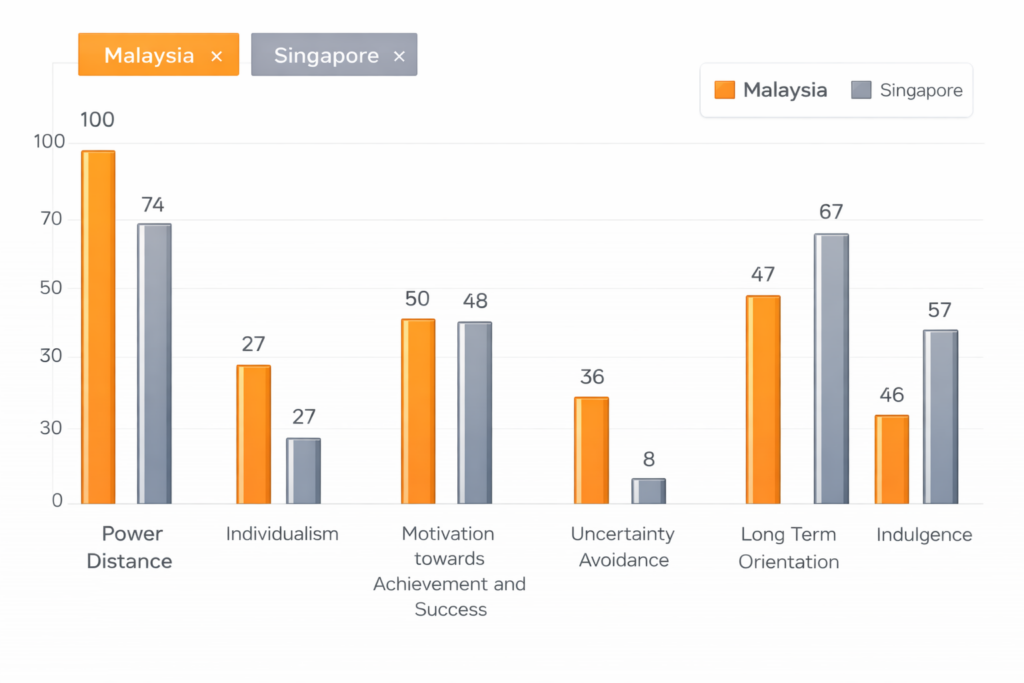
Although these two countries belong to the same region and share some historical and economic background, they are not culturally identical.
Singapore tends to be more pragmatic and competitive, with a strong need for control in long-term planning and decision-making. Despite its smaller size and population, it has a strong, financially solid economy centered around technology and efficiency, with a higher GDP.
Malaysia, on the other hand, is a multicultural and ethnically diverse country with a more visible social, religious, and political structure. It has a larger territory and population, and its economy is more focused on manufacturing and natural resources.
These differences play a key role in how digital Gaming products are positioned in the region. To achieve meaningful impact and engagement, it became necessary to apply the cultural dimensions mentioned above. This allows us to create strategies tailored to each audience while still sharing common elements that support user-centered design.
Applying the dimensions to Gaming strategies
Once we understand each dimension, the next step is to translate them into UX strategies that shape the user experience of a Gaming product, from interface design and critical flows to research, testing, and analysis.

Let’s take Malaysia as an example:
- Power Distance (100%): A high score suggests that interfaces and flows should feel structured and controlled. Users should clearly perceive authority, progression, and ownership. In Gaming, exclusivity and VIP levels, as well as clear paths to reach them, are especially important.
- Individualism (27%): Lower individualism means stronger collectivism, which is common across many Asian countries. Social proof elements such as testimonials, rankings, leaderboards, winner feeds, and community growth signals are very effective. In Gaming, leaderboards are widely used, but the strategy behind them is what truly adds value.
- Motivation toward achievement (50%): With a moderate score, competition exists but does not override the experience. Progression elements like progress bars, steppers, and guided indicators help users move forward without frustration and clearly show how close they are to their goals.
- Uncertainty Avoidance (36%): A low score means users can handle ambiguity without high stress. Still, clear steps, transparency, and immediate feedback after key actions are essential, especially in risk-related moments.
- Long-Term Orientation (47%): A balanced score suggests that short-term rewards work well, as long as they are combined with longer-term goals. In Gaming, instant rewards after simple actions like registration are effective, but sustaining motivation over time is what really matters.
- Indulgence (57%): Above-average indulgence means users value pleasure, leisure, and positive emotions. Exclusivity, rewards, recognition, and celebratory moments tend to resonate strongly with this audience.
Summary
Like any research framework, Hofstede’s cultural dimensions offer another lens to understand audiences and how products interact with them. They help teams approach users more thoughtfully from a cultural and social perspective.
Of course, these insights should always be tested and validated through qualitative and quantitative research, integrating findings into the design process to support better decision-making across the business.
I hope this article helps you better understand and empathize with your users.