
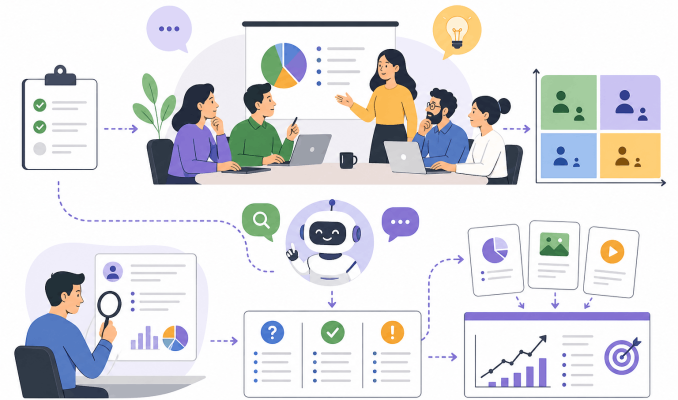
A few months ago, I had the opportunity to participate in an AI Research course led by Ann Conway, director of the agency Amplify. The course was heavily focused on how to turn LLMs into true allies throughout our research and synthesis activities during a project.
One of the strategies Ann shared was anticipating the potential questions that stakeholders may ask during a meeting where we need to present our design process, research, and final outcomes.
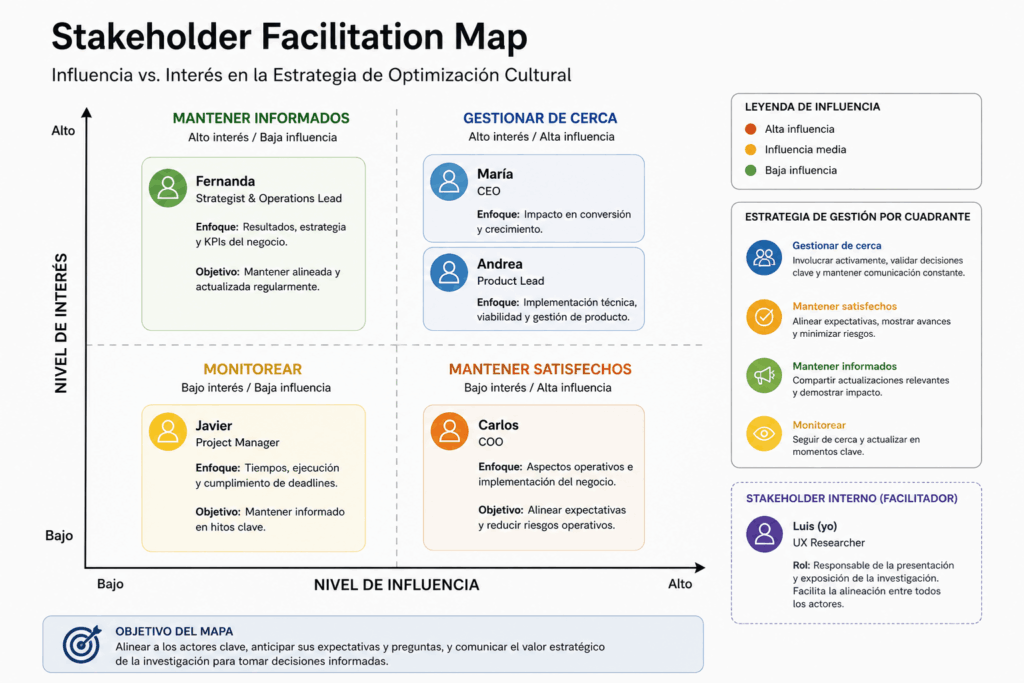
Presenting findings can be challenging for anyone contributing to a project. For this, there is a widely used technique in the design and product world known as the “Stakeholder Facilitation Map.”
Brief Overview of the Stakeholder Facilitation Map
This technique helps us identify who the people involved in the project are, what level of influence and interest they have, who we need to keep informed or satisfied, and how these factors impact decision-making.
However, this article is not focused on explaining this technique itself, since there is already plenty of theory around it. Instead, we’ll use it as a starting point. For the next steps, we need to define a scenario where we already know the project stakeholders and their level of influence and interest.
Interacting with AI
Imagine that tomorrow you have a meeting with department leadership, the project manager, and the CEO. You need to present important research findings, your design process, and the final outcome. You feel confident talking about them, but you don’t know what potential questions may come up during the meeting.
This is where we begin thinking strategically by feeding the AI with the project brief and the “Stakeholder Mapping.” Additionally, include which parts of the research you want to position, why they are important, and what impact they have had on the results.
Then identify your stakeholders. Here’s an example:
- María — CEO — Main focus on conversion impact and growth opportunities generated by the strategy.
- Carlos — COO — Main focus on operational aspects and business implementation.
- Andrea — Product Lead — Main focus on technical implementation, feasibility, and product management.
- Fernanda — Strategist & Operations Lead — Main focus on results, strategy, and business KPIs.
- Javier — Project Manager — Main focus on timelines, execution, and delivery deadlines.
- Ricardo — UX Manager — Main focus on UX/UI aspects and team management.
- Luis (me) — UX Researcher — Responsible for presenting and explaining the research.
If you want better results, you can also include personal characteristics of each stakeholder. If you’ve had previous meetings, you can add comments they’ve made, recurring concerns, or viewpoints they’ve expressed.
Example:
“Andrea has previously shown a tendency to run live testing directly on the product. Because of this, she shows some resistance toward conducting user testing before launch, likely because she believes it may slow down the process more than necessary.”
Once you’ve loaded all this information into the AI, provide a prompt similar to this:
“I need to present the following points ‘…’ in tomorrow’s meeting regarding this particular topic ‘…’. Based on the information I’ve shared about the project stakeholders, help me anticipate potential questions each of them may have. For every question, and considering the project context and the elements I want to position, help me prepare strategic responses. Create at least 3 questions and answers per stakeholder.”
Additionally, it’s valuable to challenge your own research and ask the AI to identify weak points in your strategy and possible improvements. Something like:
“Once we have mapped the strategic questions and answers, help me identify weak points that may represent a risk for decision-making, and provide pro tips to better position my research.”
Finally, you can ask the AI to help you structure a concise storytelling approach for your presentation when exposing your findings:
“Based on the points I want to position, the profile of each stakeholder, and the potential questions, help me create a step-by-step structure for my presentation.”
Your result may look something like this:
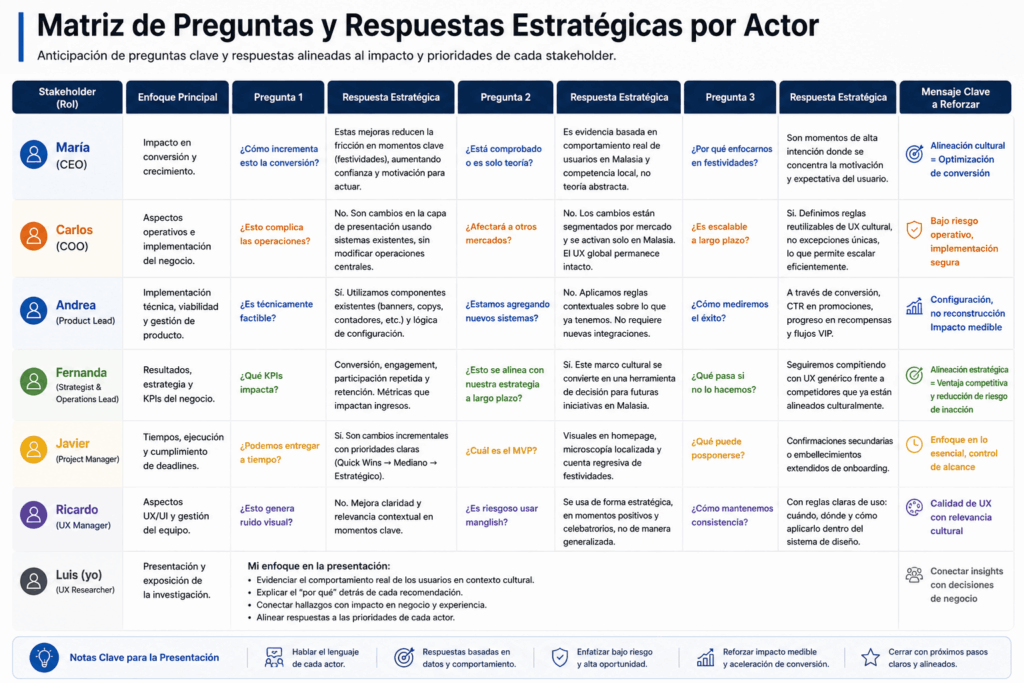
Clearly, the prompts, definitions, and refinements should ultimately come from you. Everything the AI provides should align with your strategy, and the more specific the profile of each stakeholder becomes (including qualitative information), the more refined the potential questions — and the more accurate your responses — will be.
Final Step
Now, we shouldn’t stop at the AI output alone. There is a huge opportunity to put this strategy into action and validate it after the meeting by synthesizing everything that was discussed and presented.
Create a recap of your conversation with the AI and then ask it to generate a prompt that can be copied into FigJam, Miro, or your preferred collaborative whiteboard tool.
Example:
“Based on everything we’ve worked on, create a prompt that I can paste into FigJam where I can identify each stakeholder, their questions and answers, and the main steps to position the research and storytelling.”
Your result may look something like this:
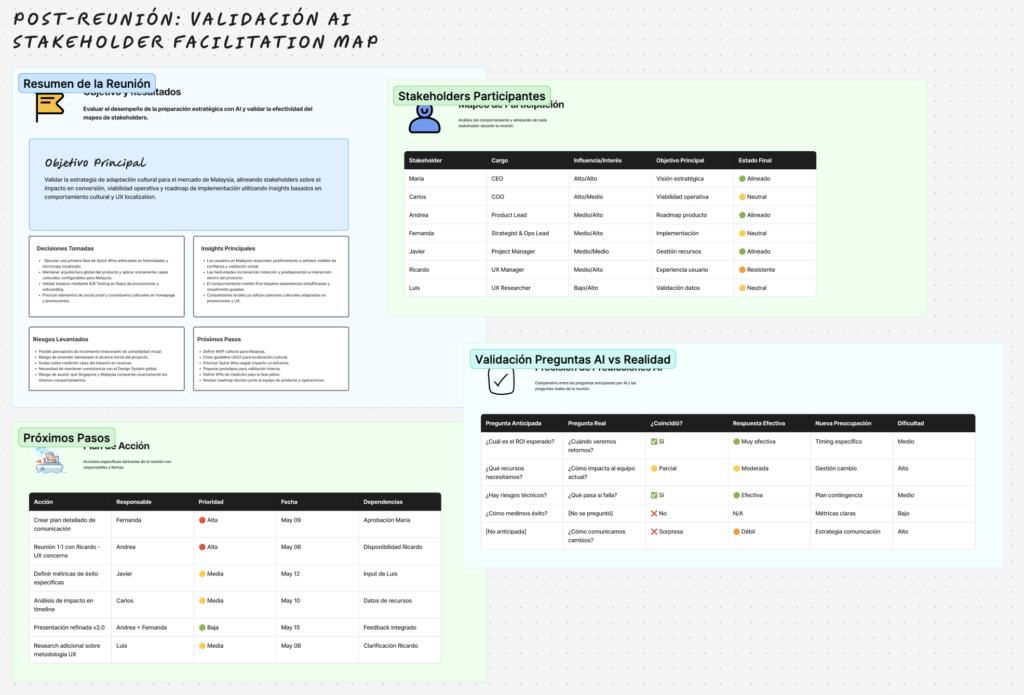
Once the meeting is over, together with your personal notes, AI notes, or meeting transcript, it’s time to move everything into your collaboration board.
Validate which of the anticipated questions actually came up:
- Did your answers match what the AI predicted?
- Were the pro tips useful during the presentation?
- What new concerns emerged?
- What can be improved for future sessions?
In conclusion, building a stakeholder mapping scenario, identifying pain points, thought patterns, tendencies, motivations, and target profiles for each stakeholder — while also anticipating potential questions and identifying weaknesses in your strategy and research — will help you stay one step ahead and strengthen the confidence behind your responses.
I hope this perspective helps you continue growing and strengthening your strategic positioning across your projects, department, or organization.